
This path is reckless: Comparing Taylor Swift songs to "Wicked" the musical
Check out this week's episode on songs that we connect to Wicked the musical!

This week on AP Taylor Swift, we’re doing something special, a Wicked-themed show and tell! With Wicked: For Good coming out soon, we’re embracing our inner theater kids and connecting Taylor Swift’s music to this beloved story. From the 1995 Gregory Maguire book to the 2003 Broadway musical to the upcoming film adaptation, we explore how “A Place in This World,” “Treacherous,” and “Now That We Don’t Talk” all perfectly capture the complex relationships and emotional journeys in the Land of Oz.
🎧 Listen above and ⬇️ scroll below to read Jenn’s extra credit about how other Wicked characters align with different Taylor Swift songs.
🛍️ Shop With Us! Active Discount Codes
As we grow, we are so excited to announce new partnerships! Here you’ll find active discount codes available to our listeners.
📚 Bookshop.org Check out all our book recommendations by episode
🔉Libro.fm Support your local bookstore while listening to great audiobooks
Code: APTS
Offer: Get a free audiobook when you start a new membership (you must use this link!)
Receive 2 audiobook credits for $14.99 USD with your first month of membership.Code: APTS30
Offer: 30% off specific audiobooks in the AP Taylor Swift playlist.
✨ Krowned Krystals Make the whole place shimmer with the best rhinestones
Code: APTS
Offer: 10% off your order when you use the link above
✨ Join us After School: Paid subscribers get our “After School” content! After School Subscribers can expect:
Monthly bonus subscriber-only episodes
Monthly subscriber-only emails with a preview of upcoming episode topics, books, & songs
Access to our subscriber-only Substack community
The chance to vote on episode topics and deep dive song choices
💟 Engagement Matters: If you’re not currently in a position to become a paid subscriber, please consider becoming a free subscriber + hitting the ‘🤍’ heart button on this post. Any/all engagement helps creators tremendously!
🎒This Week’s Extra Credit - Brought to You by Jenn
At the tail end of this week’s episode, we started chatting about what Taylor songs would work for some of the other characters in Wicked. Understandably, we spent a lot of our time in the full episode on Elphaba, Glinda, and Fiyero, but this is a complex story with a lot of interesting supporting characters. To make sure we did them justice, I wanted to spend this week’s extra credit diving into some of the supporting roles and what songs I would pick if we were discussing them.
“Look What You Made Me Do” - Nessarose’s Thesis Statement
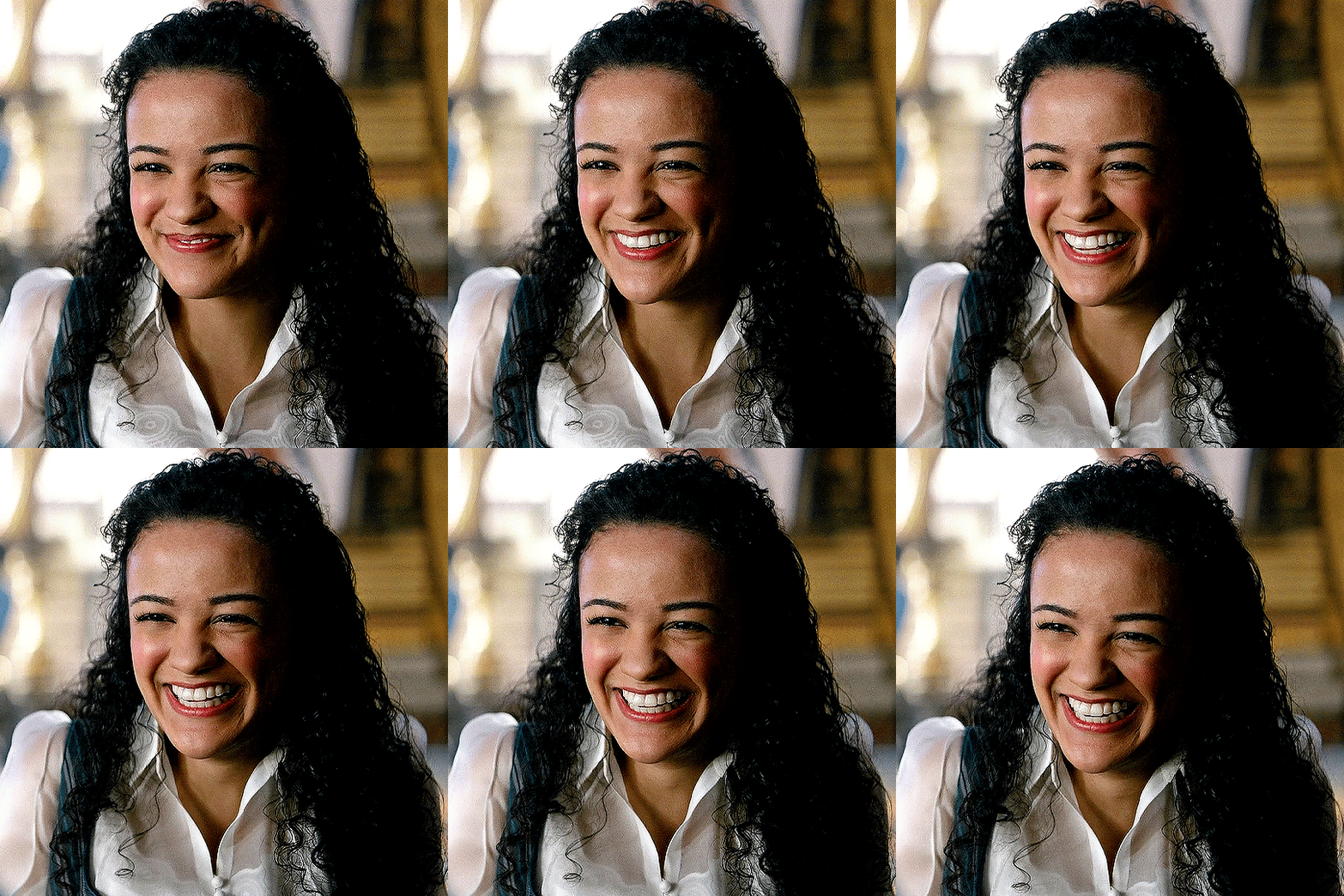
First of all, I wanted to pair Nessarose with “Look What You Made Me Do” because both her character and the protagonist of this song refuse to take ownership of their choices. Nessarose spends the entire musical blaming others for her circumstances: Elphaba for leaving her, Boq for not loving her, the world for her disability. When she finally gets power through those ruby slippers (silver shoes in the stage version, but you get it), she doesn’t use it to make things better. She uses it to control, to punish, to exact revenge on a world she believes owes her something.
Like the narrator of Taylor’s song, Nessarose is rewriting history to paint herself as the victim in every scenario. She restricts the rights of Munchkins, takes away their freedoms, and literally enslaves Boq to stay with her. And she does this all while maintaining that she’s the wronged party. “I don’t trust nobody and nobody trusts me” could be her motto as she rules through fear rather than love.
But here’s where it gets really interesting: both Nessarose and the song’s persona are trapped in performances of their own making. Nessarose performs helplessness to manipulate those around her, then performs tyranny when that helplessness is no longer useful. The old Nessarose can’t come to the phone right now because she’s dead. She killed her off the moment she got those magic shoes. And just like Taylor’s narrator, Nessarose claims she’s changed, that she’s harder and colder, but really she’s just found a new way to avoid examining her own role in her unhappiness.
The most devastating part to me is that Nessarose genuinely believes she’s owed this revenge. She believes that her suffering gives her license to make others suffer. And ultimately, her death isn’t seen as much of a tragedy except through the lens of Elphaba, her sister who loved her.
“no body, no crime” - Madame Morrible’s Specialty
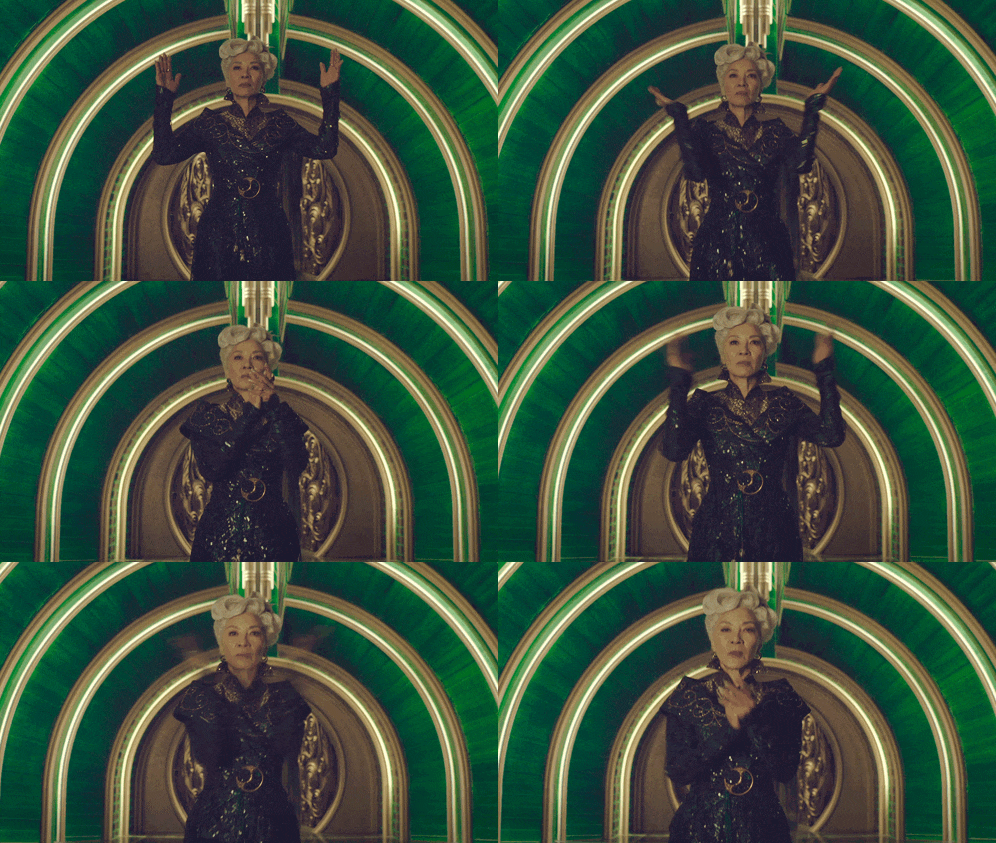
If there’s one character in Wicked who understands that the best crimes are the ones no one can prove, it’s Madame Morrible. She’s not flashy about her villainy. She doesn’t cackle or monologue. She just quietly arranges for people to disappear.
“no body, no crime” is the perfect soundtrack to Morrible’s methodology because it captures that chilling matter-of-factness about making problems vanish. Morrible doesn’t get her hands dirty with the messy work of dictatorship. She leaves that to the Wizard for that. Instead, she operates in whispers and suggestions, in strategic rumors and convenient accidents. Doctor Dillamond goes missing? How unfortunate. The other Animals lose their ability to speak? What a tragic phenomenon. Nessarose dies in a house-related incident? These things happen.
Both Taylor’s song and Morrible’s character weaponize plausible deniability. In the song, the narrator observes suspicious behavior, notices patterns, and draws conclusions, but would any of it hold up in court? Could you prove anything? Morrible operates the same way. She never explicitly orders anyone’s death. She just mentions how convenient it would be if certain obstacles were removed, and then—look at that—those obstacles disappear.
There’s also something particularly sinister about how both Morrible and the song’s narrator understand social dynamics. The song talks about the implications of her friend’s husband having an affair and covering up her own tracks to ensure the police think what the protagonist wants them to think. Morrible is a master of this. She knows exactly what to say to turn public opinion against Elphaba. She knows how to frame the Wizard as the hero and the Wicked Witch as the villain. She understands that controlling the narrative is more powerful than any magic.
But perhaps the most interesting parallel is the lack of remorse, and how we view that lack of remorse as an audience. There’s a coldness to how the song describes these calculated moves, but we feel like the cheating husband got what he deserved. Madame Morrible’s lack of remorse is much more haunting and nefarious. While both characters are brilliant at setting up people to disappear, one does it to avenge her dead friend, and the other is committing essentially a genocide. Motivation matters a lot here.
“Invisible” - Boq’s Heartbreak Manifesto
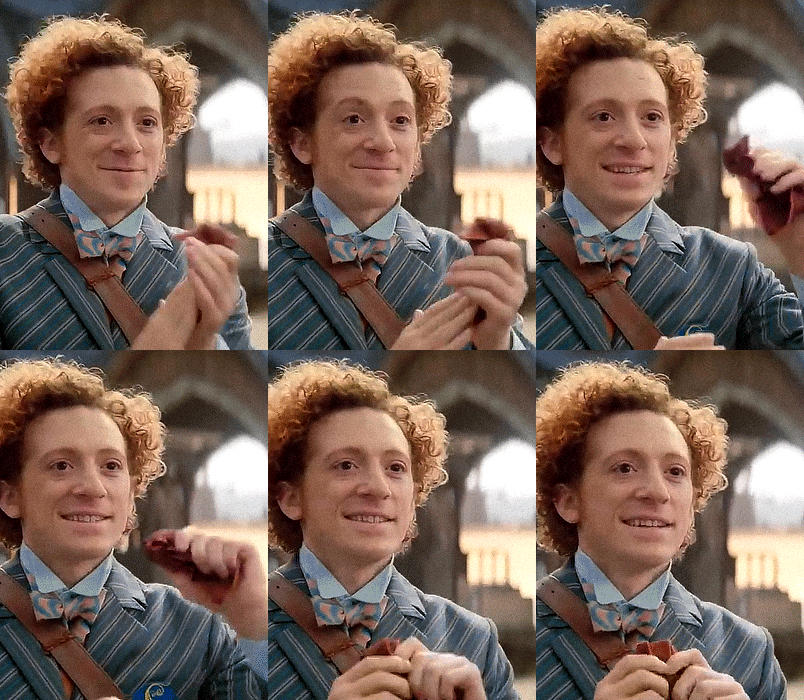
Before Boq becomes the Tin Man, before his tragic transformation, he’s just a boy who’s completely invisible to the girl he loves. And that invisibility is its own kind of curse, one that Taylor understood even back in her debut album.
“Invisible” captures the specific torture of being right there, of being the friend, the confidant, the one who sees everything, and yet somehow being completely unseen yourself. Boq spends the entire first act of Wicked worshipping Galinda (yes, with a “Ga”). He rearranges his whole life around her, follows her around Shiz, tries desperately to become someone she might notice. And she looks right through him to Fiyero every single time.
The tragedy of both Boq’s story and the song is how this invisibility becomes a self-fulfilling prophecy. Boq is so desperate to be seen that he accepts Nessarose’s attention even though he doesn’t return her feelings. He thinks that maybe if he can’t have Glinda, he should settle for being needed by someone, anyone. And that decision—to accept being seen by the wrong person instead of waiting to be seen by the right one—destroys him.
The most heartbreaking parallel is how both the song and Boq’s arc understand that being invisible can lead to desperation. In this song, Taylor sings “I just wanna open your eyes / And make you realize.” She is desperate for this boy to see what they could have together. Boq’s desperation leads to him agreeing to take Nessarose to the dance just to get Galinda’s approval, which leads him down a bath that ends with Nessarose using magic to try to make him love her. When that agic that goes horribly wrong and literally removes his heart, it’s almost poetic.
By the time Boq becomes the Tin Man, that invisibility has been made literal. He’s encased in metal, unable to feel, unable to love, unable to be hurt anymore. He wanted to be seen so badly that he ended up disappearing completely into a suit of armor.
Understanding Nessarose, Morrible, and Boq through these Taylor Swift songs shows us that the most devastating stories aren’t always about the leads. Sometimes they’re about the sister who becomes a tyrant, the mentor who’s really a monster, and the boy who loved the wrong person so much he lost himself. Turns out, Taylor really does have a song for pretty much anything!
What other Wicked characters deserve their own Taylor Swift soundtrack? Let us know in the comments!